Roof Replacement in Skiatook, OK
Bad decking is the one surprise in a replacement, and its price is settled on the estimate before the tear-off starts.
Once past patching, the question is what a full tear-off involves. Tell us what's up there and our roofers take it from here.
Roof replacement in Skiatook, OK
The part of your roof that decides a replacement isn't something you can see from the ground, because decking only shows itself once the old covering is off. Osage Trail Roofing works Skiatook replacements from there, and our roofers price what the boards turn out to be.
The timing isn't only about your house. The typical Skiatook home went up around 1987, and a good share of the older streets predates 1960. Roofs that went on in the same few years wear out in the same few years, so a neighbor's tear-off is a fair signal about your own.
Tear-off to the boards
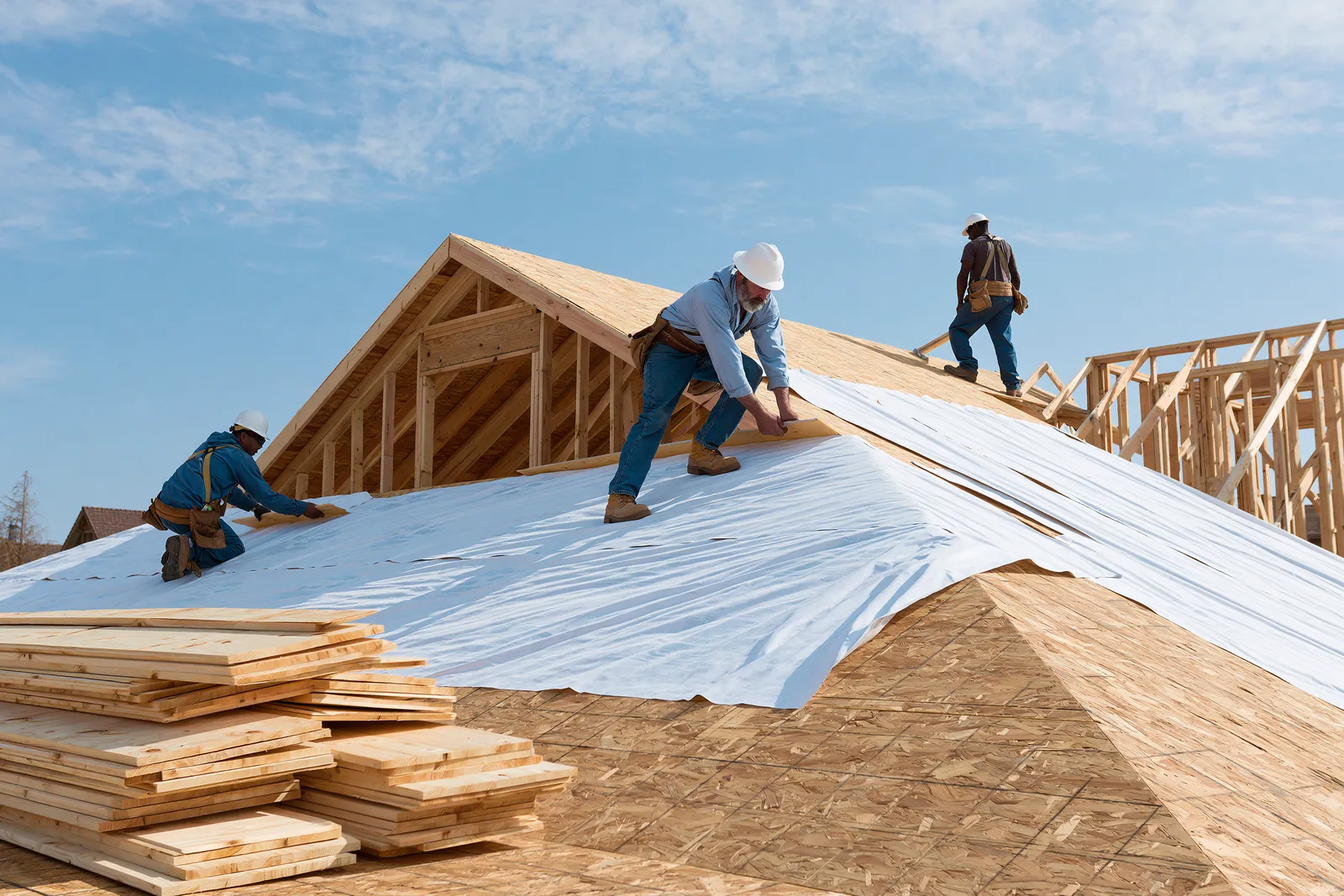
Old shingles, underlayment, flashing and nails come off from the ridge down until the deck is bare. Nothing goes back over, because a second layer traps heat and hides what's failing.
Decking checked and swapped
Our roofers stand on every sheet of the bare deck and pull the soft ones. The price per sheet is on your estimate, so a bad board doesn't become a negotiation.
Drip edge and dry-in
Drip edge goes on at the eaves, underlayment over the whole deck, then drip edge again at the rakes. That order sends water out onto the metal and off the roof.
New flashing, not reused
Step flashing, the valley metal and the pipe boots come off with the old roof and go back new. Bent flashing put back down is why some new roofs leak.
Ventilation put right
While the roof is open, soffit intake and ridge exhaust have to balance. Exhaust with nothing feeding it pulls air out of the house, and that's what bakes the shingles from below.
Two warranties, one estimate
The manufacturer covers the shingle against defects, and our roofers put their workmanship terms in writing. Both are named on the same estimate, so you'll see which paper answers which failure.
When a Skiatook roof has run out of road
Any one of these on its own is usually repair work. It's several of them together, on more than one slope and at the same age, that moves a roof from repairable to finished.
Granules fill the gutter
Those little stones washing out of the downspout are the shingle's sun protection leaving the roof. Once enough of them are gone the mat underneath dries out and splits, and there's no putting them back.
Shingle corners curl up
A corner that lifts off the deck gives the wind somewhere to start, and the next gust works the tab further. A few curled shingles is a repair, but a whole slope curling at once means the covering's aged rather than been damaged.
The deck gives underfoot
A roof that flexes where somebody steps has decking that's been wet more than once. That's a structural problem, and it settles the question of whether anything can go over the top.
Daylight shows in the attic
Stand under the roof with the lights off, and pinpricks of sky mean the sheathing has openings in it. Light gets in where water does, so it's a quick way to settle an argument.
Nail heads back out
Nails that have worked their way up push small bumps into the shingles above them and eventually break through. When fasteners across a whole slope are backing out, the deck's been moving with the seasons and the shingle isn't sealed to it any more.
Repairs keep coming back
One flashing detail that failed is a fixable problem. The same slope needing attention three times in a couple of years is money going into a surface that's already spent its life.
Off to the deck, then back up in order
The order matters more than the speed, and nothing goes down until what's under it is dry and sound. One trip up settles what the roof needs and what it costs; once the tear-off starts, a straightforward roof goes quickly, a cut-up or oversized one runs longer, and weather sets the real calendar.
Cover the ground
Your roofer tarps the landscaping and siding and sets the dumpster where it won't crack the concrete, before the first shingle comes off.
Down to bare deck
Shingles, underlayment, flashing and nails come off from the ridge down, and the whole deck ends up exposed, worn spots and sound ones together.
Judge the boards
With the deck bare, your roofer walks it and marks every soft or delaminated sheet for swapping while there's still nothing on top of it.
Dry-in and shingle
Drip edge, underlayment, starter and field shingles go on from the eave up, with new flashing woven in at every wall and valley, and the ridge vented and capped last.
What sits inside a Skiatook replacement price
Your roof's price is mostly not the shingle. Pitch changes how fast anyone can work and how much surface you've really got up there. Layers change how much has to come off and be hauled away. Decking is the one thing nobody can price from the ground, and valleys, dormers and chimneys turn open field into hand-cut detail. The Skiatook cost page carries the national averages and what moves a price inside them.
National averages are a starting point and nothing past that. You get a figure for your own roof after our roofer counts the layers and looks at the deck.
Replacement questions asked in Osage County
The questions that come up when a replacement is on the table.
Get the Skiatook roof properly measured
A replacement gets priced off a measurement, so the next move is a local roofer on your roof with a tape. What comes back is the scope and the figure for that roof on one page, itemized down to the line, so you can see what each part of the job is costing.
A closer look at the roof first.