There's water coming through your ceiling and you're already thinking about what a new roof costs. Set that down for a minute, because it isn't tonight's question. Tonight has a smaller one, and almost all of it happens indoors, at floor level. Catch the water. Move what's under it. Keep everybody out from under a ceiling that's bulging. Photograph the damage while the water is still moving. Nobody needs a ladder. Below is that first hour in order, what usually turns out to be the culprit, and how to tell a repair from a roof that's done. Take the first part now and leave the rest for tomorrow.
The first hour is about the house, not the roof
Two things are true tonight. Water's getting in, and there's nothing about the roof itself you can do from inside. So take the house instead. Put a stockpot under the drip. Move what's under the water and cover what you can't move. If the drip is near a light fixture, a fan, or an outlet, shut that circuit off at the breaker box. And when you call us, the room it's landing in and roughly when it started is enough.
One thing matters more than any bucket. If a section of ceiling is bulging, sagging, or holding water, keep people and pets out from under it and shut the door on that room. Wet drywall carries a surprising amount of weight, gives no warning, and comes down as a sheet. Don't try to drain it yourself. Getting that water down is work for our roofer or a water restoration pro.
Photographs taken tonight are worth more than the ones taken Saturday
Here's the part people skip, and it pays you back. A leak looks its worst for about two hours and then starts hiding. Drywall dries lighter, the ring around a stain fades, and the path the water took along the joist disappears. What you photograph tonight is the only version of this that'll ever exist, and it's yours.
Shoot wider than feels necessary. The whole room, so there's no question later which one. The ceiling up close. What's under it: the soaked carpet, the swollen baseboard. If water's running down a wall, get the wall. Then open the front door, stay on the ground, and photograph the weather. Your phone's stamping the time on all of it. Where a claim goes from there is covered on storm claim support.
What our roofer does before the rain stops
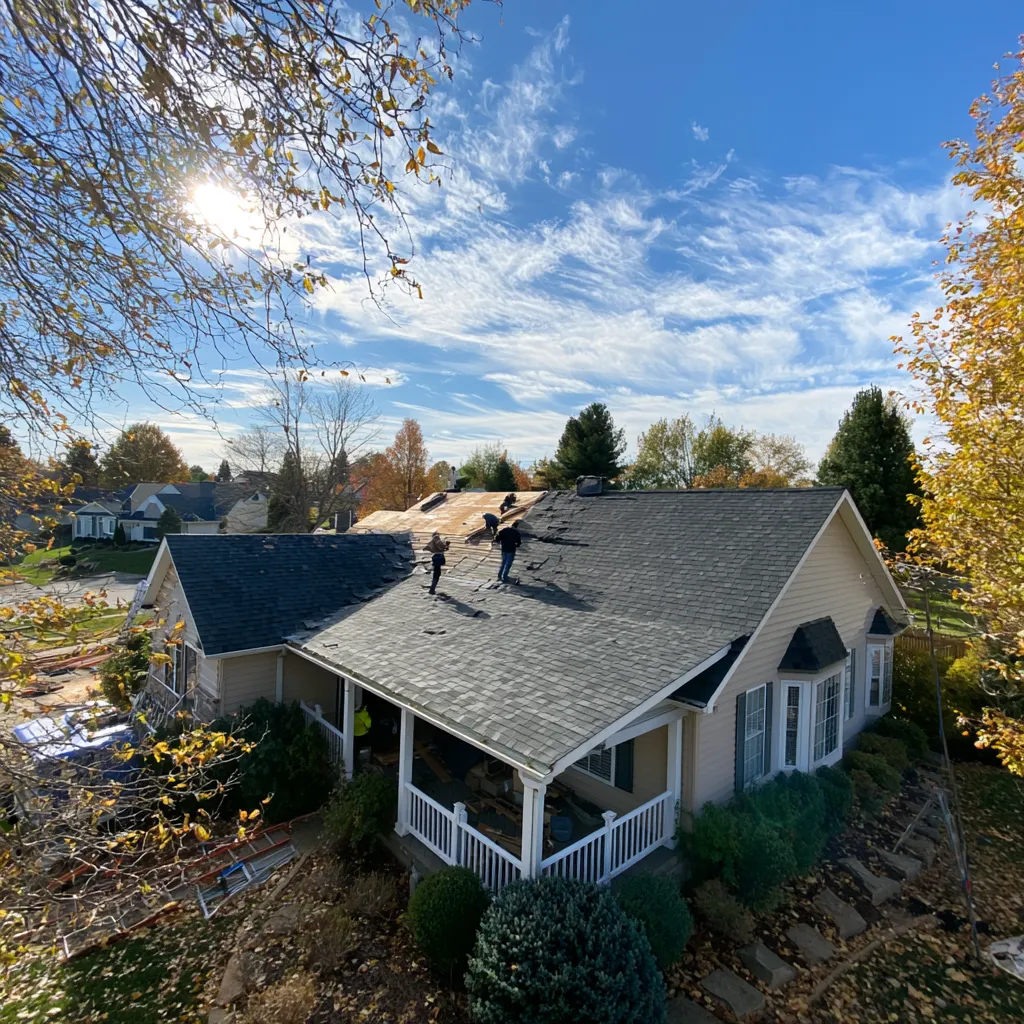
The opening itself is a roofer's job. Call Osage Trail Roofing and anything that means being up there in the rain sits with our roofer. Covering an opening does more than keep the ceiling dry. It stops the damage growing until the fix is priced, and a covered roof is a documented roof while a claim's open. Most home policies ask you to take reasonable steps to protect the house from further damage, and to keep receipts. That means making the call. It's never meant a homeowner on a wet roof at night.
Two things follow, and one costs us the job tonight. Permanent work waits: a hole closed up for good is a hole nobody can look at anymore, so keep whatever came off the roof. And if the rain has quit, nothing's dripping, and the stain is dry, this doesn't have to be tonight. It does have to happen soon. A stain that dried once comes back the next time the wind swings around.
Insurance Information Institute, Settling Insurance Claims After a Disaster.
A leak that stops when the rain stops is still a leak
Most leaks are a failure at a seam, and the shingles in the middle of a slope have little to do with it. Water gets in where the roof turns into something else: a wall, a chimney, a pipe, a valley where two slopes dump into one line. That's where the metal is, and metal is what fails.
Wind and hail leave different marks. Wind creases a shingle, and the crease is a hinge that lets water under. Hail bruises, and a bruise is a soft spot in the mat that shows up as a leak a year later. These are the failures that turn up over and over:
- Flashing where the roof meets a wall or a chimney is where most leaks start.
- A valley takes everything landing on two slopes and funnels it into one line.
- A pipe boot is the rubber collar around a plumbing vent, and sun splits it.
- A shingle creased on a wind day still lets water past.
- A nail backed out of the deck tents the shingle above it just enough to open a gap.
When a leak is the roof telling you it is done
Here's the question sitting under all of this: does a leak mean a new roof? Usually it doesn't. One traceable failure on a covering that still has years in it is a repair, and the answer can be the smaller job. Age moves the answer more than the leak does. Asphalt shingle roofs run around 20 years, so the same leak at year seven and at year nineteen are two different conversations.
What tips it is a pattern instead of one bad day. Leaks turn up in three different places over two seasons. The field goes brittle enough that lifting one shingle cracks the two beside it. A second layer is already nailed up there. You see daylight through the decking from inside the attic. Osage County has logged 23 hail days in four years, 30 of the 39 reports at an inch or larger, so roofs here age faster than the calendar suggests. Either way, the leak has to be found before it can be stopped, and that starts with a call. Roof repair in Skiatook covers what comes after, and a look at the whole roof is what settles the age question.
NAHB Study of Life Expectancy of Home Components. Osage County hail counts from NOAA / NCEI Storm Events, 2023 to 2026.